
Radial piston motor or orbital motor.What's inside the undercarriage.
The data sheet often lists only a manufacturer's name for the travel drive. Behind it are two types of hydraulic motor that both drive the tracks and still behave differently under load. Here you can read how the orbital motor and the radial piston motor work and when the more expensive piston motor pays off for your work.
 Travel drive · Technology & costs
In short
- Light to medium workOrbital motorCompact, affordable, widely used
- High continuous loadRadial piston motorMore pressure, brake inside the motor possible
- What decides itYour useHours, terrain, attachment
Two designs for the same job
Both motors turn oil pressure into rotation, and both are low-speed motors: they deliver a lot of torque at few revolutions. That is why on small tracked loaders they sit directly at the drive sprocket, with no gearbox in between. The difference is on the inside.
In the Orbital motor, also called an orbit motor or gerotor, an inner gear runs inside an outer ring that has one more tooth. The oil fills the chambers between the two one after the other and pushes the inner gear on. It is simple, compact and affordable.
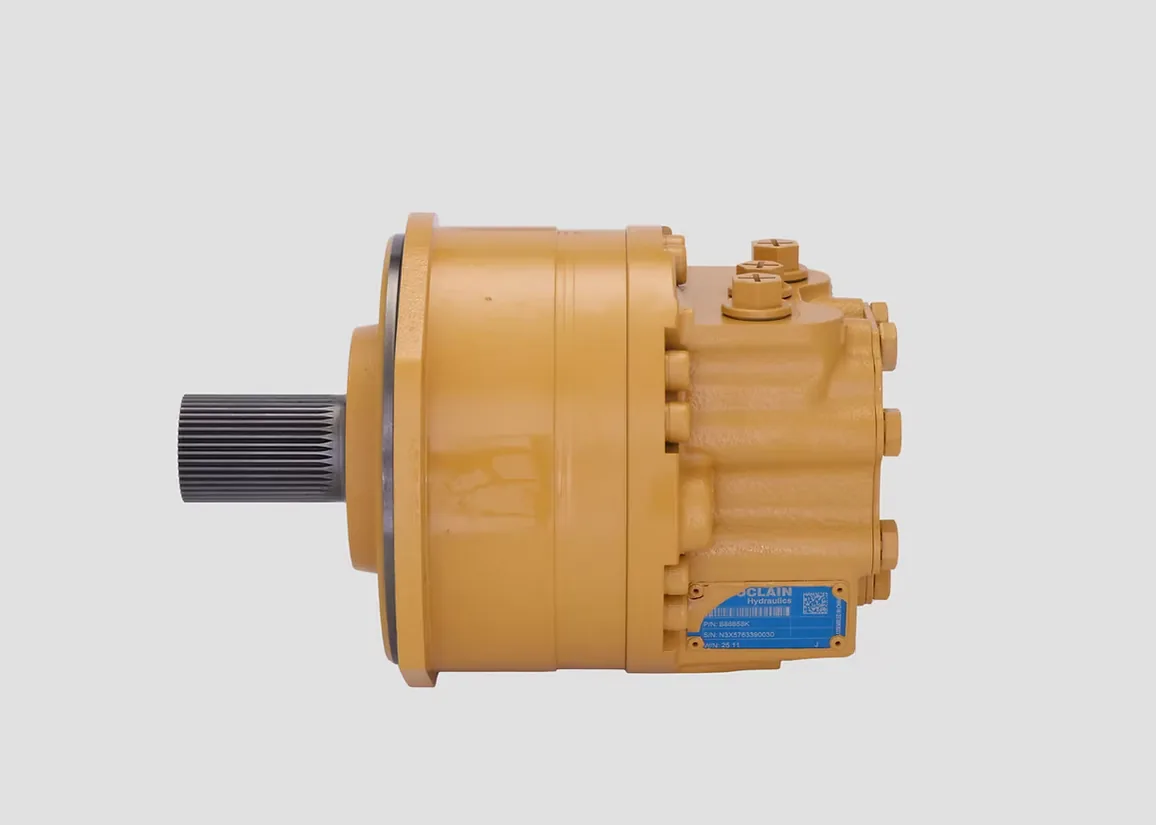
In the Radial piston motor several pistons stand in a star shape in a cylinder block. Oil pushes them outwards, and their rollers run against a cam ring with several lobes. Each piston therefore works several times per revolution. More parts and more manufacturing effort, but this design withstands much higher pressures.
Pressure makes the difference
The torque of a hydraulic motor results from displacement and pressure. Whoever can take more pressure gets more force from the same size. The manufacturers' figures show the gap:
| Motor | Pressure according to manufacturer | What that means |
|---|---|---|
| Orbital motor Danfoss OMS | 210 bar continuous, 275 bar for short periods | Peaks only up to 10% of every minute |
| Radial piston motor Poclain MS02 | up to 450 bar | Up to 2,500 Nm from 398 cm³ |
| VMENG SAM 1950, travel drive | up to 400 bar | Poclain piston motors, up to 10.8 km/h |
In daily use you notice it on a slope with a full bucket, when pushing into a pile of soil, or when the mulcher bites in and the machine should keep creeping forward anyway. There, an orbital motor reaches peak values it may only hold briefly. A radial piston motor still has reserve at that point.
Where you notice it on the job
Travel drive and attachment hang on the same hydraulics. The oil the travel motor loses internally turns into heat and is missing elsewhere. Radial piston motors seal with pistons in bores rather than across gear flanks. That is why they lose less oil, especially at slow speed under high load.
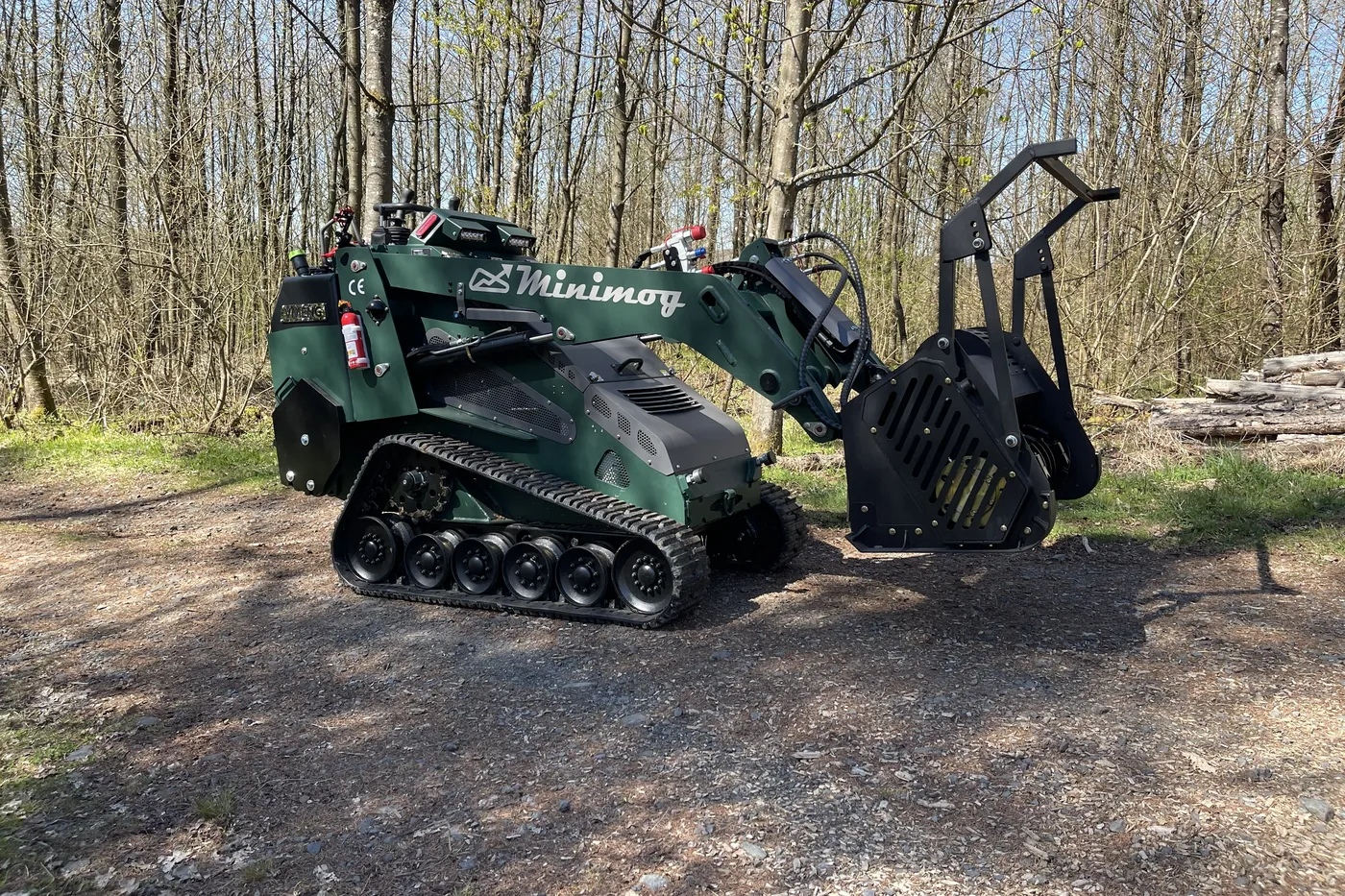
This counts for jobs that run for a long stretch: forestry mulcher, trencher, rotary tiller, snow blower. There the machine drives at creep speed while the attachment draws a lot of oil. The SAM 1950 with 79.8 l/min at the attachment and its Poclain travel motors is built for this kind of work.
When moving paving material around a garden, with breaks for unloading, this difference hardly matters.
Brake, creep speed and dirt
In its MT travel motors for tracked loaders, Poclain builds in a multi-disc brake that a spring closes and oil pressure releases. If the pressure drops, the machine stands still. The manufacturer also describes smooth, precise movements even at very slow travel. That helps when manoeuvring with a load close to a wall, fence or vehicle.
For tracked-loader motors, Poclain also names seals that withstand caked-on mud and a direct drive without a planetary gearbox that needs no maintenance. For every machine, ask how the parking brake is built. This applies to both motor types.
When the orbital motor is perfectly enough
The orbital motor is the simpler design. It is affordable, compact and copes comparatively well with contaminated oil. You can get replacements from many manufacturers, and many small loaders have been running reliably with it for years.
- You mainly move material: soil, gravel, pallets.
- The machine runs a few hours a week, not eight hours every day.
- Your attachments need little oil: bucket, pallet forks, auger, grapple.
- The terrain is level or only slightly sloping.
If this applies to you, the piston motor buys you reserve you will rarely call on. If, on the other hand, you mulch, mill or work on slopes every day, take a close look.
The VMENG models with Poclain drive
At Derette, three compact loaders run with Poclain piston motors. You operate all three standing up.
| Model | Width | Operating weight | Tipping load | Travel |
|---|---|---|---|---|
| SAM 1000Z Max | 915 or 1,070 mm | 1,515 kg | 1,426 kg | 7.96 km/h |
| SAM 1200 | 915 or 1,070 mm | 1,650 kg | 1,555 kg | 7.96 km/h |
| SAM 1950 | 1,134 mm | 2,150 kg | 2,591 kg | 10.8 km/h |
What to ask the dealer
A manufacturer's name in the brochure is not enough. These questions clarify what is really inside the undercarriage:
- Which design and which series is the travel motor?
- For what continuous and peak pressure is the travel drive designed?
- Where is the parking brake, and what happens if pressure is lost?
- What does a replacement motor cost, and how fast does it arrive?
- Who repairs it, and in which workshop?
The other points for your purchase are in the checklist for buying a compact loader. For machines from the Far East, the article Mini diggers and compact loaders from China.
also helps. You feel the difference best yourself. Drive the SAM 1200 or the SAM 1950 at a demonstration on your own ground, preferably with the attachment you use most.
Frequently asked questions
What is an orbital motor?
A hydraulic motor in which an inner gear runs inside an outer ring with one more tooth. Oil fills the chambers between them one after the other and so turns the shaft. Other names are orbit motor and gerotor motor.
What types of hydraulic motor are there?
The usual designs are gear motor, orbital motor, axial piston motor and radial piston motor. As low-speed motors directly at the wheel or drive sprocket, it is mostly orbital and radial piston motors.
How efficient is a hydraulic motor?
It depends heavily on pressure, speed and oil temperature, and manufacturers give performance maps for it. A single percentage says little. At slow speed under high load, radial piston motors lose less oil through internal leakage than orbital motors.
Is an oil motor the same as a hydraulic motor?
Yes. "Oil motor" is the colloquial name for a hydraulic motor, whatever its design.
Can I swap an orbital motor for a piston motor?
Not easily. Connection dimensions, pressures, pump, valves and brake have to fit together. That is a decision for the machine manufacturer, not a retrofit part.